
Hidden Camera Detector App vs. RF Detector: Which Works Better?
 Andrew·
Updated June 2026·
6 min read
Andrew·
Updated June 2026·
6 min read
Search "hidden camera detector" and you'll get two very different answers: a $30 handheld gadget with a blinking antenna, and an app that runs on the phone you already own. They work in completely different ways. Here's how they actually compare, and when each one is worth using.
The quick answer
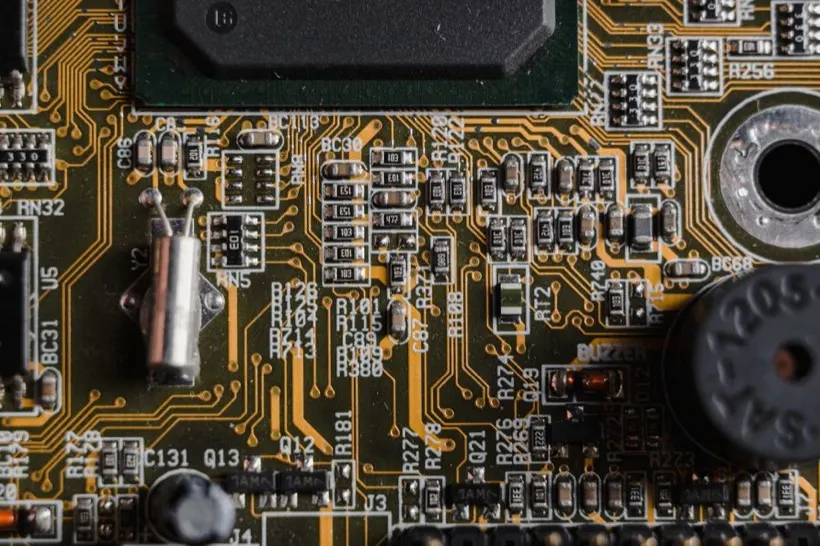
An RF detector listens for radio signals. It can help in trained hands, but it beeps at anything that transmits, including your own phone, the router, and the TV, and it goes quiet on a camera that records to a memory card instead of streaming. A detector app like Spyzero looks three ways at once (network, optical, and magnetic) and tells you what a device is, not just that a signal exists. For travelers and renters, the app is the more practical and informative tool. For a professional sweep, dedicated RF gear still earns its place alongside other equipment.
| Can it… | Detector app (Spyzero) | Handheld RF detector |
|---|---|---|
| Identify what each device is | Yes | Signal only |
| Scan Wi-Fi for networked cameras | Yes | No |
| Spot lens reflections and infrared | Yes | No |
| Flag magnetic anomalies | Yes | No |
| Catch offline, SD-card cameras | Often | No |
| Ignore harmless electronics | Mostly | No |
| Work with no extra hardware | Yes | No |
| Keep the cost low | Free to low-cost | $25 to $150+ |
| Stay easy to use | Yes | Takes practice |
How an RF detector works (and where it struggles)
An RF detector measures radio-frequency energy in the air and lights up or beeps when it gets close to a transmitter. Because a wireless camera streaming video is a transmitter, the basic idea is sound. The trouble is in the day-to-day use:
- It can't tell a camera from a microwave. Everything that uses radio sets it off, so you spend the sweep chasing your own phone and the room's router.
- It misses cameras that don't transmit. A camera saving footage to an SD card gives off little or no signal, so an RF-only sweep walks right past it.
- It's easy to misread. Signal strength shifts with distance and obstacles, and reading that well takes practice most travelers don't have.
None of this makes RF detection worthless. Professionals use high-end spectrum analyzers for exactly this reason. But a cheap consumer RF wand is a blunt instrument.
How a detector app works
A detector app uses sensors your phone already has, and the better ones combine several methods so the weak spots cancel out:
- Wi-Fi scan: lists the devices on the network and flags camera-like ones by name, vendor, and open ports. That's the specificity an RF detector lacks.
- Camera scan: spots the infrared glow of night-vision cameras and the reflection of a lens, which works whether or not the camera is online.
- Magnetometer scan: surfaces concealed electronics by their magnetic signature, including some devices that never transmit at all.
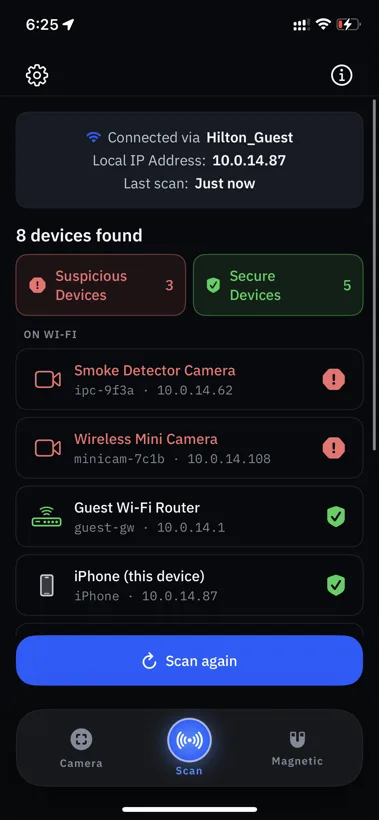
The real difference is three methods versus one. Spyzero runs all three scans, so a device that shows up on the network and reflects a lens is a real lead, not a guess. That cross-checking is something an RF wand simply can't do.
The verdict
If you're a traveler, a renter, or anyone who just wants a quick, reliable check, a detector app wins on every practical front: nothing extra to carry, far fewer false alarms, and it actually identifies what it finds. A handheld RF detector is best seen as one specialized tool for people running formal counter-surveillance sweeps, and even then it's used alongside optical and physical inspection, never on its own.
Three scanners, no extra gadget
Spyzero runs Wi-Fi, infrared camera, and magnetic scans from your iPhone. Your scans never leave your phone.

Frequently asked questions
Do RF detectors actually find hidden cameras?
Only transmitting ones. An RF detector finds radio signals, not cameras. It reacts to a wireless camera that's actively streaming, but also to phones, routers, and other electronics, and it's blind to a camera recording to a local SD card.
Is a phone app or an RF detector better?
An app, for most people. It scans the network to identify cameras by name, checks for infrared and lens reflections, and sweeps for magnetic anomalies. An RF detector only signals that some radio source is present nearby.
Why does my RF detector beep at everything?
Because it reacts to all radio. Your own phone, the room's router, a smart TV, or a neighbor's electronics can all trigger it. That lack of specificity is the main weakness of RF-only detection.